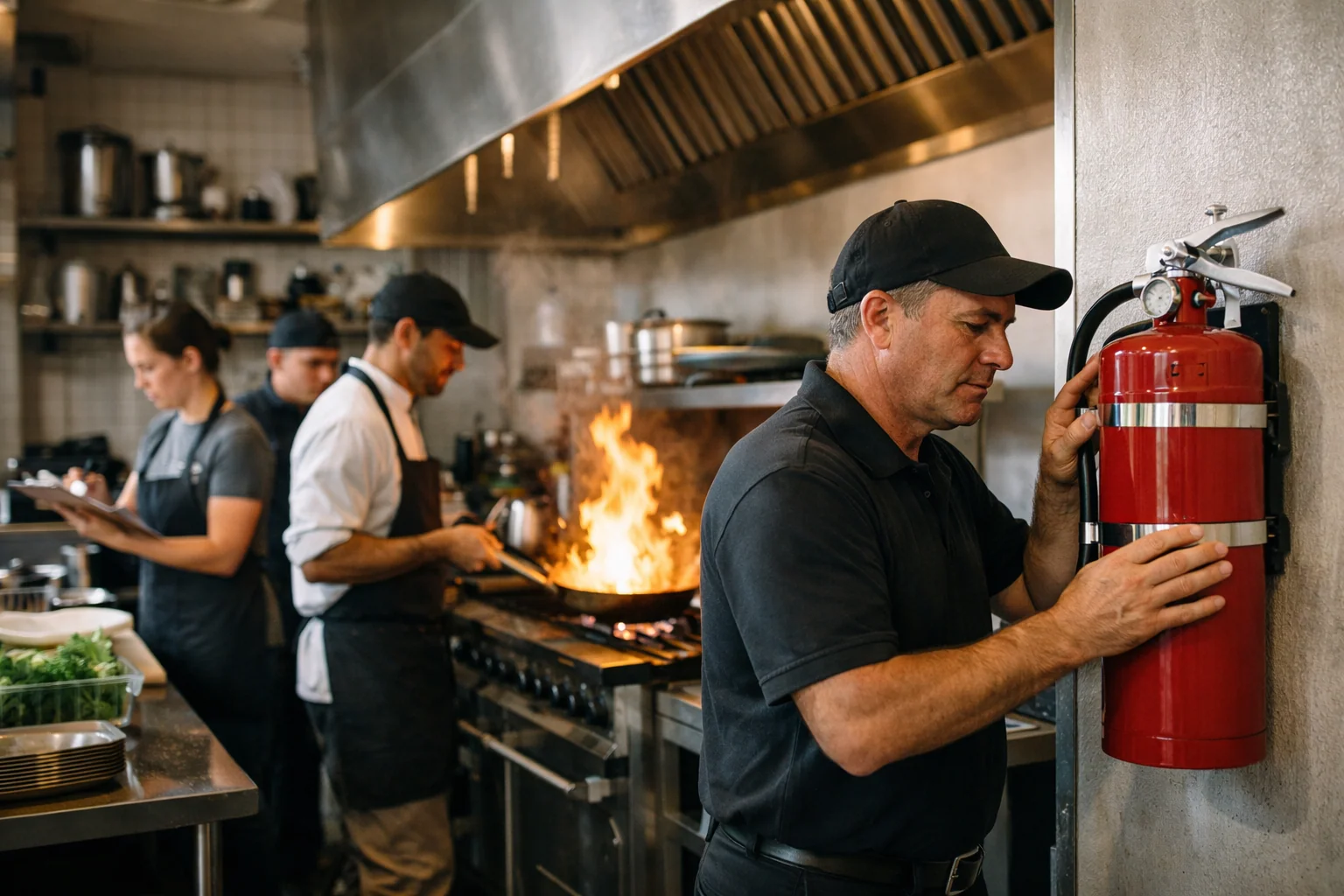
Your hood suppression system is the main defense against a grease fire. But it isn't the only one. Every commercial kitchen also needs portable fire extinguishers, and the right type matters a lot.
Here's what the code expects, what your staff can handle, and what needs a certified technician.
You need a Class K extinguisher
Kitchens with cooking oil or grease need a Class K extinguisher. This is a wet chemical unit made for cooking media fires. Portland's fire code requires it. So does NFPA 10, the national standard for portable extinguishers. Portland enforces the 2018 edition.
Class K agent forms a foam blanket over burning oil. That cools the surface and seals off the air. It also helps stop the fire from reigniting.
Your extinguisher should be within 30 feet of the cooking equipment, by travel distance. That's the walking path, not a straight line.
Don't grab the wrong extinguisher
A standard ABC dry chemical extinguisher is common in kitchens. It can knock down flames on hot oil, but the oil stays hot. The fire can reignite after the flames go out.
Both types can be in the building. Just make sure your staff know which one to grab for cooking oil. If there's no Class K near your fryers and range, that's a gap.
Cooking oil fire? Class K. Everything else in the kitchen can use your ABC units.
Monthly checks vs. annual maintenance
NFPA 10 splits the work into two parts.
Monthly quick check (anyone can do this). Walk by every extinguisher at least every 31 days and look for these:
- It's in its place and easy to reach
- The pull pin is in with an intact tamper seal
- The gauge is in the green zone
- No dents, corrosion, leaks, or blocked nozzle
- The service tag is current
Write the date and your initials on the tag or a log.
Annual maintenance (certified technician). Once a year, a certified technician does a full exam. That covers the mechanical parts, the agent, and the pressure. The technician replaces the tamper seal and updates the service tag.
Some units need extra service
Beyond the annual exam, some extinguishers have longer intervals. Wet chemical units need an internal exam every 5 years. Stored-pressure dry chemical units need one every 6 years. Hydrostatic testing is also due on a set schedule, depending on the type.
A good technician tracks these dates for you and flags them early.
Train your staff
Having an extinguisher isn't enough. Anyone working in the cooking area should know how to use one. That means knowing when to use it, and when to leave.
Pull the suppression system first
If a fire starts under the hood, the order matters:
- Pull the manual pull station for the suppression system
- Get everyone out
- Call 911
- Use a portable extinguisher only if the fire is small and you have a clear exit behind you
The suppression system does the heavy lifting. The extinguisher is the backup.
A quick checklist
- Class K extinguisher within 30 feet of cooking equipment
- Monthly check logged
- Annual maintenance by a certified technician
- Current service tag on every unit
- Staff trained on use
- Everyone knows to pull the suppression system first
Already scheduling your suppression system inspection? We can service your extinguishers on the same visit.
Need your extinguishers serviced?
Timberline Fire Systems services portable fire extinguishers and inspects suppression systems for restaurants and food trucks across the Portland metro. Contact us to get on the schedule.