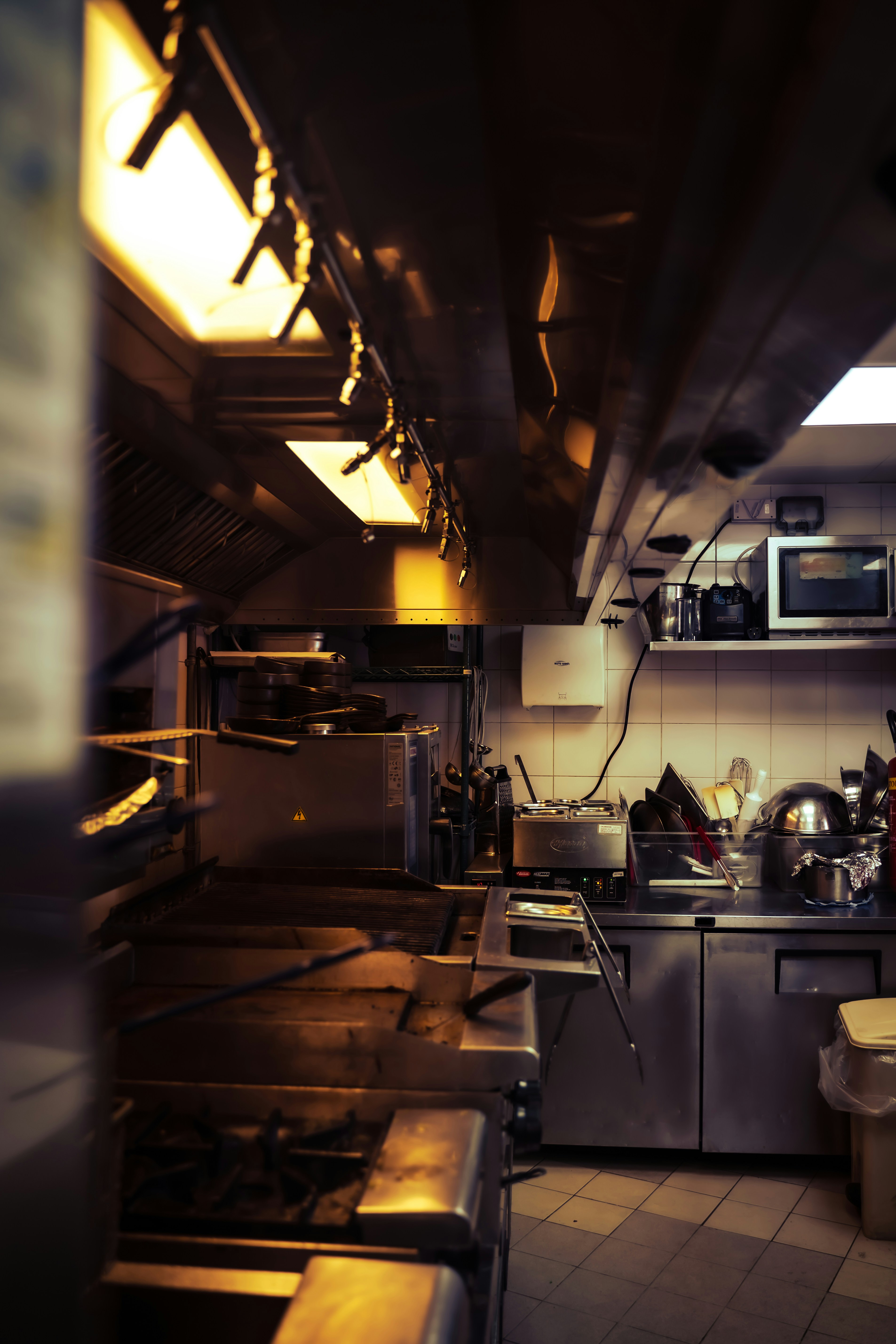
Most restaurant operators have never seen their suppression system activate, and never want to. But understanding roughly how it works makes the twice-a-year inspection make a lot more sense, and helps explain why certain components get so much attention.
Detection comes first
Every wet chemical system relies on fusible links, small heat-sensitive components positioned above your cooking equipment. These links are built to separate at a specific temperature. Until that happens, they're holding a cable under tension that keeps the system in its resting state.
When a fire pushes temperatures past that threshold, the link separates. That's the entire trigger. No electronics, no sensors, no power required. It's a purely mechanical detection method, which is part of why these systems are so reliable: there's very little that can fail silently.
What happens the instant it trips
Once a link separates, the tension it was holding releases, and that pulls a mechanical trip mechanism. That trip punctures a small gas cartridge, which pressurizes the system's agent tank almost instantly.
From there, the pressurized wet chemical agent travels through fixed piping to nozzles positioned over your fryers, griddles, and cooking surfaces, and discharges.
Why wet chemical agent specifically
The agent is a potassium-based solution, and it doesn't just cool the fire the way water would. When it contacts hot cooking oil, it triggers a chemical reaction called saponification, the same basic chemistry behind making soap. The oil's surface converts into a soapy foam layer almost instantly.
That foam blanket does two things at once. It smothers the fire by cutting off oxygen, and it cools the surface enough to prevent the oil from reigniting once the fire's out. That second part matters more than people realize. A grease fire that looks extinguished can reflash if the oil is still hot enough, which is exactly what the foam layer is built to prevent.
The system doesn't just discharge, it shuts things down
A properly installed system is tied into an interlock with your gas or electrical supply to the cooking equipment. When the system activates, that connection cuts fuel to the appliances automatically, so the fire isn't still being fed while the agent works.
This interlock is one of the components we specifically test during every inspection, since a suppression system that douses a fire but leaves the gas running isn't doing its full job.
There's also a manual option
Every system has a manual pull station as a backup to the automatic fusible link trigger, positioned within a specific distance of the hazard so it's reachable in an emergency without walking through the fire itself. Pulling it fires the system exactly the same way a tripped link would.
Why this matters for your twice-a-year inspection
Every part of that chain, the fusible links, the gas cartridge, the piping, the nozzles, the interlock, the pull station, has to function correctly for the system to work as designed. That's why an inspection isn't just a visual check.
An inspection is a verification that every link in that mechanical chain is still capable of doing its job the one time it actually needs to.
Ready to have yours checked?
Timberline Fire Systems inspects wet chemical suppression systems for restaurants and food trucks across the Portland metro. Contact us to schedule an inspection.